Posted by: Editor | January 27, 2012

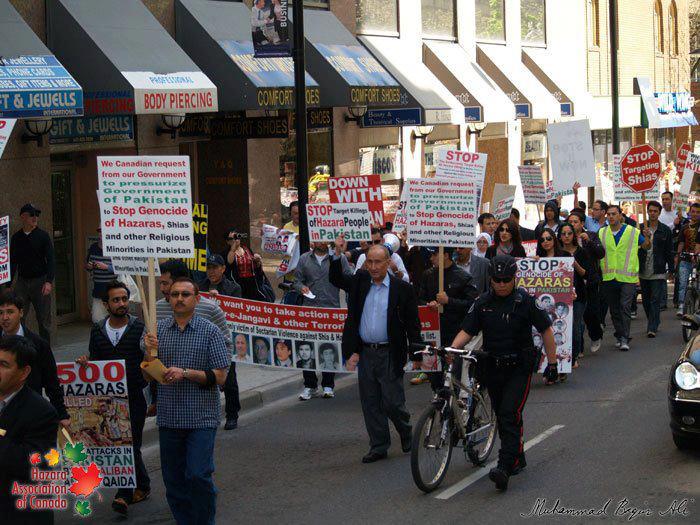
Hazara Democratic Party Stages Protest

From Express Tribune

Quetta: Hazara Democratic Party (HDP) on Thursday staged a noisy protest demonstration outside the Balochistan Assembly building, against the targeted killing of three people belonging to their community in Quetta.

Inspector of Federal Investigation Agency (FIA) Vilayat Hussain, TV actor Abid Nazish and Mohammad Anwar were shot dead by unknown assailants on Wednesday night in Quetta, in what appeared to be an incident of sectarian killing. However, no outfit had claimed responsibility for the killings.

Protestors marched through various roads and held a demonstration on Zarghoon Road outside the Balochistan Assembly building. They were carrying placards and banners with messages against target killing.

They raised slogans against the government and the chief minister for their failure to overcome the growing incidents of target killing and kidnapping for ransom in Quetta.

Vice President of HDP Mirza Hussain said Hazara community was being subjected to target killing for the past several years and the government had failed to launch a crackdown against the criminals. “Government should answer who are the target killers? And how they carry out deadly attacks with complete impunity,” he added.

Kidnappings on Quetta-Chaman Highway

Protestors said four people belonging to Hazara community were kidnapped a few days ago from Quetta-Chaman highway and were still missing. “The kidnappers approached the families and asked for a huge amount as ransom for the release of these four people,” one of the protestors said.

HDP warned that they will hold protest demonstrations across the world where Hazara community is residing, to lodge their protest against the organised target killings if government and law enforcing agencies failed to protect the innocent lives.

“We are Pakistanis and do not want to give a bad name to our country by holding protest in other countries. But now we are being pushed against the wall and left with no option,” Hussain said, adding that Hazara community is demanding an end to the target killing and kidnappings.

Meanwhile, Provincial Ministers Ayinullah Shams of Jamiat Ulema-e-Islam-Fazl (JUI-F) and Sultan Tareen of Awami National Party (ANP) addressed the protestors and assured them that government will soon hold a meeting to review the law and order situation.

Posted by: Editor | January 25, 2012

3 Hazaras Shot Dead

Famous Hazara actor and PTV artist Abid Ali Nazish.

Quetta Jan 25: Three Hazara were murdered on McCongy Road Quetta on Wednesday. The victims include famous Hazara actor and artist Abid Ali Nazish, Federal Investigation Agency Inspector Wulayat and a poet Muhammad Anwar. They were traveling in a car, when unknown armed men on a motorcycle opened fire and escaped the scene.

They died on the spot, being shot on head. Their bodies were immediately shifted to Civil Hospital Quetta, and later taken to Alamdar Road. It is the first incident of targeted-killing against Hazaras in Quetta in 2012. According to a report by Human Rights Watch around 275 Hazaras have been killed in Balochistan since 2008.

Posted by: Editor | December 4, 2011

275, mostly Hazara, killed in Balochistan since 2008: HRW

Quetta: Human Rights Watch has called the Pakistani Government to hold accountable extremist groups for killing. In statement, HRW said:

Human Rights Watch research indicates that at least 275 Shias, mostly of Hazara ethnicity, have been killed in sectarian attacks in the southwestern province of Balochistan alone since 2008.

The report mentions two worst attacks on Hazaras in 2011.

On October 4, gunmen on motorbikes stopped a bus carrying mostly Hazara Shia who were headed to work at a vegetable market on the outskirts of Quetta. The attackers forced the passengers off the bus, made them stand in a row, and then opened fire, killing 13 and wounding 6 others.


On September 19, near the town of Mastung in Balochistan, gunmen forced about 40 Hazara who had been traveling to Iran to visit Shia holy sites to disembark from their bus. They shot 26 dead and wounded 6. Although some of the Hazara escaped, gunmen killed another three as they tried to bring the wounded to a hospital in Quetta. Lashkar-e-Jhangvi, a Sunni militant group, claimed responsibility for this attack.

Human Rights Watch said no one has been charged in these attacks. It said, “While authorities claim to have arrested dozens of suspects, no one has been charged in these attacks.”

HRW also said the militant extremist groups have links to Pakistan’s military and intelligence establishment.

Some Sunni extremist groups are known to have links to the Pakistani military and its intelligence agencies. Groups such as the banned Lashkar-e Jhangvi operate with impunity even in areas where state authority is well established, such as Punjab province and the port city of Karachi. In Balochistan, where local militants challenge government authority, and elsewhere across Pakistan, law enforcement officials have failed to intervene or prevent attacks on Shia and other vulnerable groups.

HRW also called tThe Pakistani government to urgently act to protect Shia Muslims in Pakistan from sectarian attack during the Muslim holy month of Moharram. Hazaras have come terrorist suicide bombings during Muharram. In March 2004, when a suicide bomber attacked a Muharram procession, 42 Hazaras were killed.

Read HRW statement on their website.

Posted by: Editor | November 24, 2011

Hazara MNA Ends Boycott on Prime Minister’s Assurance

Hazara member of National Assembly from Quetta Nasir Shah ended boycott of the NA session after the Prime Minister’s assurance to meet his demands. Prime Minister Syed Yusuf Raza Gilani went to Nasir Shah who was camping outside the National Assembly building. The Prime Minister requested Nasir Shah to end the boycott and join the NA proceedings.

Nasir Ali Shah was on a sit-in strike in front of the National Assembly for more than a month protesting against the targeted-killing of the Hazaras in Quetta. He had boycotted the NA sessions on the issue and demanded his ruling party PPP to impose Governor’s Rule in Balochistan, where the corrupt Provincial Government under Chief Minister Raisani has turned a blind eye towards the massacre of Hazaras.

Nasir Shah thanked the Prime Minister and went to the National Assembly with him saying he would continue to raise his voice for the people of his province.

Hazara community finds safe haven in Peshawar – Asia – Al Jazeera English.

The ethnic group Hazara make up about 18 per cent of Afghanistan’s population, but many have been forced to flee persecution and war in their country.

More than half a million Hazaras now live in Pakistan, but there too they have been targeted by religious extremists for their Shia Muslim beliefs.

In Balochistan, where most of Hazaras reside, the group Lashkar-e-Jangvi has declared an open war against them. At least 90 Hazaras have been killed since July 30.

But the historic city of Peshawar in the northwest has welcomed them with open arms, and trade seems to be thriving for many members of the small community.

Al Jazeera’s Kamal Hyder reports.

Posted by: Editor | November 13, 2011

Conference in London on Genocide of Hazaras

Posted by: Editor | November 7, 2011

Seminar in Lahore Against Killing of Hazaras

By Hussain Kashif, Daily Times

LAHORE: Progressive people of Punjab and Hazara passed a joint resolution demanding the government carry out a ‘targeted operation’ like Karachi against the religious extremists involved in killing of Hazara Shiites in Balochistan, which is the only way to resolve this problem in the province.

Punjab Lok Sangat (PLS) in cooperation with Awami Party Pakistan and Institute for Peace & Secular Studies organized a seminar against the brutal killing and massacres of Hazara Shiites living in Balochistan since hundreds of years here at Lahore Press Club on Thursday. Senior journalist (Daily Times’ Editor) Rashed Rahman presided over the seminar while a representative of the Hazara community from Balochistan Muhammmad Ahmad Kohzar and PLS patron Amjad Saleem Minhas were the chief guests. Activists and workers of different non-governmental organizations, political parties including Communist Mazdoor Kisan Party, Awami Jamhoori Forum, Labour Party Pakistan, Anjuman-e-Taraqi Pasand Musanafeen and others also participated in the seminar in a large number.

The participants passed a resolution demanding the government to establish its writ in the province and carry out a targeted operation against religious extremists to stop the brutal killing of Hazara Shiites in Balochistan where more than 0.6 million citizens belonging to the Hazara community were facing a horrible situation since 2001 and hundreds of their members had been killed and burned.

The resolution further demanded the government end the insecurity among the Hazaras by taking action against the religious extremists in Balochistan and that the Pakistani establishment should stop its backing to these extremists (sectarian), who are totally anti-society and humanity, for using them for their own purposes of continuing the power-game in the country in general and in Balochistan specifically.

Earlier, addressing the gathering in his key speech, Rashed Rahman said that the Hazara community in Balochistan was one of the most peaceful and hardworking and was being targeted for the only purpose of strengthening Mullahism there. He said that the Hazara people were living in Balochistan since hundreds of years so they should be treated on equal basis as they were also the sons of the same soil like the Baloch and the Pashtuns.

Talking about the Afghan war and the Balochistan issue, Rashed Rahman said that politicians like Imran Khan who were saying that the war against terror was an American-imposed war were wrong as Zulfiqar Ali Bhutto was the first person who directed General Naseerullah Babar at that time to prepare the Mujahiddin against Afghan President Sardar Muhammad Daoud Khan in 1973 because he (Bhutto) had a fear of his (Daoud) support to insurgents in Balochistan resisting the military operation. Later, some of these Pakistani-promoted Afghan leaders like Rabbani, Mujaddadi, Hekmatyar played prominent roles in the Afghan wars, he added.

Rashed Rehman further said that Tehreek-e-Taliban in Pakistan was the result of the Pakistani military’s policy of exporting jihad to Afghanistan. He clarified that ‘good’ Taliban and ‘bad’ Taliban were meaningless terms as all Taliban factions had a nexus and were linked to al Qaeda. He said that Punjab was a power centre of the establishment, representing 62 percent of the population of the country but unfortunately they were unaware about the affairs of Balochistan so there was a need to educate them on the issues, which was the only way to bring change in policies, politics or in the social order.

Hazara representative Muhammad Ahmad Kohzar while addressing the gathering clarified that the Hazara community of Balochistan had no link with the Hazara region (Abbottabad area). They (the Hazara people) are Turk-Mongol and were living in Balochistan since the age of Chengiz Khan, a Mongol Emperor, and most of them are religiously Shia Muslims, he confirmed. He also informed that more than 0.6 million Hazara people were living in Quetta city alone, while a good number of his community was in Afghanistan and Iran.

Kohzar told the audience that the Hazara people were being victimized in Balochistan since 2001 but they were peaceful people so would not want any clash with anyone or bloodshed on the streets of Quetta. He said that the Pakistani establishment was involved in the sectarian war in Balochistan and using extremists against the peaceful people of the area. He confirmed that the Baloch or Pashtuns of Balochistan had no problem with the Hazara people. He alleged that Lashkar-e-Jhangvi, a sectarian extremist organization backed by the establishment was directly involved in the killings of Hazara people and due to such victimisation, thousands of his people (Hazara) had left the country.

He emphasized that the government should establish its writ in Balochistan starting a ‘targeted operation’ against the sectarian culprits in Quetta, Mastung, Kharotabad and other districts. He further urged the government to change its foreign policy, avoiding considering Afghanistan as its province and should maintain good relations with Afghanistan and other neighbouring countries.

Amjad Saleem of PLS said that religious victimisation was increasing in Balochistan because of the neglect of the government and extremists had become more powerful against the state there. He assured the Hazara people that all progressive elements in Punjab and other parts of the country were fully in support so they should not consider themselves as alone. Syeda Deep, Shazia Khan, Irfan Comrade, Yousuf Punjabi, Zahid Hassan, Tahir Malik, Rafi Jamal were also present in the seminar while Khalid Mehmood of Awami Jamhoori Forum hosted the seminar.

Posted by: Editor | November 6, 2011

Suicide Attack in Hazara Town

Quetta: A suicide bomber died when his explosives blew while he was trying to enter the crowded Hazara Town on Saturday. Reports confirm that two other bombers fled the area without executing their terror plot in Hazara Town.

Police Superintendent Malik Arshad said “the man wanted to place the explosives somewhere in Hazara Town, however, it detonated near the drain line, killing the man instantly.”

According to Express Tribune, “the explosion left a three-foot-deep ditch, and limbs and pieces of human flesh could be found 35 to 40 yards from the crime scene. The victim’s legs and arms were separated from the body, while his head and abdomen remained intact.”

The police recovered a wallet from the crime scene and found a copy of the victim’s identity card which states his name as Pervez Elahi, a resident of Dera Allahyar.


Posted by: Editor | October 20, 2011

Killings of Hazaras: makings of genocide?

By Mohammad Taqi, published on Daily Times, Oct 20

“War doesn’t negate decency. It demands it, even more than in times of peace” — The Kite Runner.

Anyone who has read Khaled Hosseini’s novel, The Kite Runner, or watched its heart-rending film adaptation need not be reminded that the above quote was an Afghan man’s response to a Russian soldier on the verge of a war crime claiming, “This is war. There is no shame in war.” The man’s son tried to stop him from standing up to the Russian. The Kite Runner remains a poignant parable of what has gone wrong with Afghanistan and Pakistan. That war has ravaged both countries is obvious but the hit that common decency has taken goes almost unnoticed.

Hosseini’s character Amir and his decision, first to not do anything when his friend and half-brother Hassan is subjected to an atrocity and then to keep his father from intervening to stop violence, is a stark reminder that the perpetrators’ strength is compounded by the inaction of the bystanders. In the allegorical work, the epithets and slurs thrown at Hassan — the jovial, loyal and young representation of decency and more importantly Afghanistan itself — are the abyss staring us in the eye.

Unfortunately, the disaster and slurs are not limited to fiction any longer. After the recent massacre of the Shiite Hazaras near Mastung, the parliamentarian from the area — Ayatullah Durrani — suggested on a television show that the victim community benefits by getting Australian asylum. Aslam Raisani, the chief minister of Balochistan, where more than 500 Hazaras — over 90 in the past four months — have been killed, offered to send a truckload of tissue papers to the bereaving families. Many seasoned human rights campaigners have either remained mum or have issued subdued statements literally sanitising the premeditated mass murder underway in and around Quetta. Terms like ‘sectarian killings’, with connotations of a tit-for-tat warfare between equal groups for similar motives, have been deployed.

Mass murders do not happen in a vacuum or out of the blue. There are always indicators of the disasters in the making, which are ignored by the bystanders, euphemised by the enablers and denied by the perpetrators. Prevention of such catastrophes has been a subject of serious scholarship and among the warning signs the most important one is a history of similar atrocities. Professor Barbara Harff had aptly noted: “Perpetrators of genocide are often repeat offenders, because elites and security forces may become habituated to mass killing as a strategic response to challenges to state security.”

The Hazaras first came to the Quetta cantonment in the then British Balochistan from central Afghanistan after the Afghan ruler, Abdur Rahman Khan, prompted by clergymen from Kandahar, issued a decree in 1892 declaring the Hazaras infidels. He ordered them to convert to the Sunni faith and when they refused he followed up on his pledge to exterminate them. A similar edict was issued by the Taliban regime of Mullah Omar in 1998 followed by extermination campaigns such as Mazar-i-Sharif (1998), Robatak Pass (2000) and Yakaolang (2001). The Hazaras have lived in peace and relative prosperity in Quetta and have been considered model citizens of Pakistan. But that was until another series of edicts was unleashed against them by the Lashkar-e-Jhangvi (LeJ) — the Pakistani affiliate of the al Qaeda-Taliban combine.

It is in this very specific context that recognising the vulnerability of the Pakistani Hazaras takes on an urgency that no human and civil rights activist can ignore. Over 600,000 members of an easy-to-profile community, largely residing in the Marriabad area near Alamdar Road and the Hazara Town off the old Brewery Road in Quetta have become sitting ducks given the callous government attitude and a determined and well-armed perpetrator. The responsibility of bearing witness, raising concern and proactive advocacy rests now with the media and human rights activists.

Within the human rights community there is reluctance to use the term genocide and a departure from the confines of the 1948 UN Convention on the Prevention and Punishment of Genocide, which provides a legal definition of the crime, is considered almost a judicial heresy. In a situation where the legal framework has not kept pace with time and the intervention and prevention of a disaster cannot wait, a working definition provided by John Thomson and Gail Quets may provide a useful start. They had stated: “Genocide is the extent of destruction of a social collectivity by whatever agents, with whatever intentions, by purposive actions which fall outside the recognised conventions of legitimate warfare.”

Even within the confines of the UN definition — based on the efforts of Raphael Lemkin — the atrocities do not have to be state-sanctioned, happen only in war or in peace, or a certain number of the target population have to die before the invocation of the term could be considered. Extermination of the last member of a community does not have to happen — in fact not one person has to be killed — for the crime to become genocide. Any ‘stable and permanent group’ (which can be national, ethnic, racial or religious) is considered a protected group. The responsibility for protection, of course, rests squarely with the state. In its 2007 judgement in the Bosnia vs Serbia case, the International Court of Justice (ICJ) for the first time defined the scope of the state responsibility under the UN convention. The ICJ has set strenuous evidence standards for a state to be held responsible for direct commission of genocide. But it also imposed an equally strict onus upon the states to rein in the non-state perpetrators to prevent genocide.

Nadezhda Mandelstam, a survivor of the Stalinist gulags herself, writes in Hope against Hope, “The relentless keepers of the truth are the genocide’s most powerful opponents…those who fail to witness honestly — who turn away, distort, and deny — are reliable allies of the génocidaires.” Interestingly, Nadezhda means hope in Russian. One remains hopeful that the international and Pakistani human rights organisations and activists would help bear witness, chronicle and report what appear to be the makings of genocide. The Pakistani state, on its part, must remember that failure to avert an imminent catastrophe would land it in very dubious company.

The writer can be reached at mazdaki@me.com. He tweets at http://twitter.com/mazdaki

Islamabad: Interior Minister Rehman Malik visited the Hazara parliamentarian and member of ruling PPP outside the parliament house. He assured Nasir Ali Shah that solid steps would be taken to ensure peace in Quetta. He said that on directives of President Zardari, he will be visiting Quetta next week to ensure action in some particular areas demanded by the Hazara delegation in a meeting with President Zardari.


Islamabad: President Asif Ali Zardari called on a delegation of Hazara in Islamabad. He said,

“the heavy hand of the government will fall on all those elements behind the attacks on members of Hazara community,”

The President directed Interior Minister Rehman Malik to visit Quetta immediately and take up the issue with the Balochistan Government to make sure all possible actions are taken against the targeted killings of Hazaras. He called for a report on the arrests made so far and registered progress in the cases. He also asked for the submission of reasons in case no arrests had been made so far or in case no cases had been initiated.

Posted by: Editor | October 10, 2011

Hazara Community Starts Migrating

Report on Pakistan Observer

Peshawar—The Hazara community members started migrating to Peshawar due to the increase in target killing incidents in Balochistan.

At least 54 Hazara people from Quetta, Pashin and different areas of Balochistan shifted to Peshawar as the target killings of Hazara have increased in the province.

The Hazara community members hired houses on rent in different localities of Peshawar city. It merits to mention here that people from different walk of life hailing from Hazara divisions were moved to Quetta in search of jobs and business.—Online

Posted by: Editor | October 10, 2011

Samaa TV Show on Hazara Genocide in Quetta

Part 01

Part 02

Part 03

Posted by: Editor | October 10, 2011

The less said the better

By Abbas Nasir

Dawn, October 08

OUR military and its various arms and agencies believe they have what it takes to formulate and execute the country’s foreign and national security policies.

The recent multiparty conference, rather fallaciously called all-party conference even though there were notable absences, saw carpet coverage by our TV news channels during which a range of opinion was heard.

Among the ‘expert’ commentators whose opinion one benefited from was an academic-analyst who is said to have personal experience of counter-espionage and, while working for a security agency in the national interest, was reportedly responsible for the expulsion of a foreign spy.

In the opinion of these experts, the political parties were bereft of the wherewithal (as manifested in the absence of think tanks/experts and research papers) to formulate foreign/national security policies. Therefore, the vacuum was filled by the military.

They cited the ‘excellent research’ being carried out at army institutions such as the National Defence University, the papers that are published there, the lectures by faculty and guests of substance and expertise as the reason for the military’s ‘superiority’.

Let us not go into the detail of what for example the civilian politician Zulfiqar Ali Bhutto delivered to the country in terms of successful foreign and national security policies. We won’t look at the Simla agreement that saw 90,000 prisoners of war return home and the Islamic Summit.

We won’t get into whose policies lost us half the country and made 90,000 of its proud soldiers prisoners of wars. We won’t even ask whose brilliance had pushed us into the Kargil disaster and how another ‘bloody civilian’ Nawaz Sharif got us out of the Himalayan mess.

We won’t even get into who did what to these civilian leaders after they bailed out the most powerful of our institutions or

shall I say political entities.

We will accept the assessment of our patriotic sons and daughters, analysts and commentators, and say, yes, the military is the only institution with the intellect, the paraphernalia to draw up policies to safeguard our country’s interests.

But then of course they’ll also have to agree that as the sole arbiter of policy, the military must be held to account when things go pear-shaped. And, boy, pear-shaped things have gone wherever you look.

Look at Balochistan. Nearly 500 murders of a relatively small community of Hazara Shias over the course of a few years ought to have been enough for everyone having any responsibility for law and order in the province to be spurred into action.

But no one seemed to take notice. Now the violence against this community has reached mind-numbing proportions as demonstrated by the mass execution of Hazara Shia bus passengers near Quetta in two separate incidents barely a few weeks apart.

And these mass murders claimed by one of the most lethal sectarian terror groups, Lashkar-i-Jhangvi, have come against the backdrop of continuing disappearances of Baloch nationalists seen as being too close to the separatist cause.

Trying to gain an insight into an increasingly murky Balochistan scene I approached someone whose knowledge of the province I have come to rely on over the years even though we may have often disagreed over his pro-establishment worldview.

“You see the resources of the security agencies are limited. So first they are focusing their attention on those who are trying to break up Pakistan at the instigation of foreign powers. Once they have dealt with the threats to the country’s existence, they’ll deal with sectarian groups too.”

I couldn’t believe my ears. But once the meaning of the remarks started to sink in disbelief was replaced by insane rage.

Eventually, of course I was to break out in cold sweat at the thought our national security was in the hands of ones so wise, so prudent.

Okay. You might say such thoughts are completely unsurprising and unremarkable coming from someone who is always pro-democracy (no matter how imperfect) and against the meddling of military in the civilian domain (no matter how grave the civilian shortcomings).

But look at what a recently retired inspector-general and one of the most respected police officers in the country Tariq Khosa wrote earlier this week in a national daily: “…Balochistan is fast slipping into chaos and turmoil that may result in [the] disintegration of the State of Pakistan.”

He laments the “lack of political will and wisdom to set things right”. But goes on to say: “The security establishment has a barrel vision as its current strategy is perpetuating tit-for-tat killings and violence.”

Khosa is very open about the shortcomings of the police but says: “The Frontier Corps looks up to the army command rather than the Ministry of Interior to respond to acts of terrorism and disorder in the province.

“A huge force is being fed gigantic internal security allowance out of limited financial resources of the province, and yet it is not accountable and responsive to the needs of the provincial government….”

“Intelligence Bureau, the civilian police-led agency of the Federal Government, has been made ineffective as power lies somewhere else. Its role in Balochistan is to act as glorified partner of the local special branch.

“The military-led all-powerful ISI is not willing to part with its administratively acquired technological prowess for intelligence-based investigations against the terrorists and insurgents. About Military Intelligence (MI), less said the better in the context of Balochistan.”

Khosa justifiably laments the lack of political will and wisdom. Many of us feel that the PPP-led government in Islamabad may be forgiven for many of its sins but its expedient silence over Balochistan will forever be a black mark against its name.

And, to pick up on Khosa’s phrase, the less said the better about how the guardians of our national security and how their role in Balochistan will be judged by history.

The writer is a former editor of Dawn. abbas.nasir@hotmail.com

Posted by: Editor | October 10, 2011

ہزارہ دوستوں کی کچھ یادیں

شرجیل بلوچ

بی بی سی اردو ڈاٹ کام، کوئٹہ

شاید میں چار برس کا تھا یا پھر پانچ کا۔ کوئٹہ کے نیچاری محلے میں رہنے والی ایک ہزارہ عورت نے مجھے دو بڑے سمندری سیپ دیے تھے۔ یقیناً میں اسے ’کیوٹ‘ لگا ہوں گا۔ مجھے اس کا نام یاد نہیں لیکن اسکے سرخ و سفید گول مٹول چہرے نے خود ہی اپنا نام گڈولی آنٹی رکھوا لیا ہو گا۔ آج تینتیس چونتیس برس بعد بس اتنا یاد ہے کہ گڈولی آنٹی ہر وقت مسکراتی رہتی تھیں۔

اسی محلے میں ایک منگول شکل کا نان بائی بھی تھا۔ کڑی سردی میں علی الصبح جب میں اس کے تندور پر گرما گرم نان لینے کپکپاتا ہوا پہنچتا تو وہ سب سے پہلے مجھے نان اتار کر دیتا۔ محلے میں رہنے والے کچھ ہزارہ بچوں کا خیال تھا کہ میں انکی طرح گول مٹول تو ہوں مگر رنگ کا سانولا ہوں جیسے ان کا پسندیدہ ہیرو ’بروس لی‘ چنانچہ میری شناخت کے لیے انہوں نے میرا نام بھی بچہ بروس لی رکھ دیا۔

آج کی طرح اس وقت بھی گول مٹول ہزارے باکسنگ، فٹ بال، کراٹے اور تن سازی کے دیوانے تھے۔ میری والدہ کی زیادہ تر سہیلیاں ہزارہ تھیں۔ اس بات کا کوئی مطلب ہی نہ تھا کہ ہزارہ شیعہ ہیں اور باقی لوگ سنی۔ بلکہ عاشورے کے جلوس میں پیاسے سوگواروں کو شربت پلانے میں سارا محلہ جٹ جاتا تھا۔ میرے والد بھی اس کام میں آگے آگے ہوتے۔ نام تو ان کا انوار الحق ہے مگر ہزارہ انہیں محبت سے انور علی پکارتے تھے۔

آج کی طرح اس زمانے میں بھی یہ جاننا مشکل نہیں تھا کہ کس علاقےمیں کتنے ہزارہ آباد ہیں۔ جن علاقوں کی گلیوں اور محلوں میں شام کو پانی کا چھڑکاؤ کیا جاتا ہو، صاف ستھری دوکانوں میں اشیاء سلیقے و ترتیب سے رکھی ہوں، شور و غل بہت کم ہو، ہریالی زیادہ ہو، چادر پوش خواتین اور بچے صبح کی چہل قدمی پر نکلے ہوئے ہوں تو سمجھ لیں کہ وہاں ہزارہ آبادی کی اکثریت ہے۔ یہ لوگ صحت و صفائی کا اتنا خیال رکھتے ہیں کہ دھوئیں سے بچنے کے لیے کسی گھر میں چوبی چولہے پر روٹی نہیں پکتی۔ صرف سالن تیار ہوتا ہے اور روٹی تندور سے خریدی جاتی ہے۔

جس طرح کراچی کے پارسیوں کے بارے میں مشہور ہے کہ اگر کسی کو سیکنڈ ہینڈ گاڑی خریدنی ہے تو پارسی کے ہاتھ کی گاڑی سے بہتر کوئی سودا ممکن نہیں اسی طرح کوئٹہ میں آج بھی یہ راز سب جانتے ہیں کہ بیس برس پرانی موٹر سائیکل بھی ہزارے سے خریدنی چاہیے۔ یہ بھی سب جانتے ہیں کہ ہزارے کے رکشے میں سفر کرنا سب سے محفوظ اور بہتر ہے۔ نہ تو وہ اضافی کرایہ مانگتے ہیں اور نہ ہی آپ کا سامان گم ہوگا۔ اول تو وہ آپ کی بھولی ہوئی شے خود ہی ڈھونڈھ کر پہنچا دے گیں اور ایسا نہ ہوا تو اپنی ایسوسی ایشن کے دفتر میں جمع کرا دے گیں تاکہ آپ نشانی بتا کر لے جائیں۔

تعلیم اور تعلیم کے ساتھ ساتھ محنت بھی۔ان دو ہتھیاروں کے بل پر پانچ لاکھ نفوس پر مشتمل ہزارہ کمیونٹی آپ کو کاروبار سے لے کر ملازمت میں نمایاں دکھائی دے گی۔ آپ ناموں سے بھی اندازہ لگا سکتے ہیں۔ مثلاً جنرل محمد موسیٰ جو ایک معمولی سپاہی سے ترقی کرتے کرتے پاکستان آرمی کے سربراہ بنے اور پینسٹھ کی جنگ میں فوجی قیادت کی۔

پاکستانی فضائیہ کی پہلی خاتون پائلٹ سائرہ بتول ہزارہ ہیں۔ آغا عباس وہ شخص ہے جس نے تازہ پھلوں کے جوس کو پاکستان میں پہلے پہل تجارتی بنیاد پر ’آغا جوس‘ کے نام سے کراچی میں متعارف کرایا۔ ابرار حسین باکسر ( ستارہِ امتیاز ) نے لاس اینجلس، سیول اور بارسلونا اولمپکس میں پاکستان کی نمائندگی کی اور بیجنگ کے ایشین گیمز میں سونے کا تمغہ جیتا۔ مگر شائد ابرار حسین کے قاتل کو ابرار کی کامیابیوں کے بجائے صرف اس کا عقیدہ معلوم تھا۔ بھلا محسن چنگیزی کی شاعری اور خادم علی کی مصوری سے کون واقف نہیں؟

دو برس قبل جب میں کوئٹہ گیا اور بچپن کے ایک ہزارہ دوست سے ملا تو اس کی دو سالہ چینی گڑیا اپنے کھلونوں میں مست تھی۔ میں نے پوچھا کیا نام ہے میری گڑیا کا تو اس نے اٹک اٹک کر بتایا ب۔۔ب ۔۔بتول۔

اس سے پہلے کہ وہ میرا نام پوچھتی، میرے دوست نے کان میں سرگوشی کی اسے اپنا پورا نام مت بتانا ۔۔۔ڈر جاتی ہے۔

مجھے اس بحث میں فی الحال نہیں پڑنا کہ ہزارہ کمیونٹی ان دنوں کیوں اور کن جان لیوا حالات سے گزر رہی ہے لیکن مجھے جب بھی ان کے بارے میں کوئی ایسی ویسی خبر ملتی ہے تو لگتا ہے جیسے کسی نفسیاتی مریض نے کسی لڑکی کے چہرے کو تیزاب سے اس لیے جھلسا دیا ہو کہ وہ اتنی حسین کیوں ہے؟؟؟

Posted by: Editor | October 10, 2011

More of the same

By Gulmina Bilal Ahmad

Daily Times, October 07

This week, I could not agree more with columnist Munir Ataullah when he confessed to being “stumped” as he sat down to compose his column. I share his predicament although the reasons are different. Week in and week out, as I struggle to present my erratic thoughts in some kind of a structured piece, I am more frustrated than stumped. Not to sound clichéd, but it truly feels that the more things change, the more they remain the same. Figures change day in and day out, locations change and victims change. However, the injustice, crime and leaders paying lip service and doling out empty, hollow assurances of the ‘perpetrators’ being brought to justice remain tragically the same.

The Hazara community of Balochistan, admittedly a relatively more educated and socially mobile community, is being targeted again because of its religious beliefs. I am reminded of a picture depicting two aliens witnessing the commotion and violence on earth and saying to each other, “They are fighting over whose religion is the most peaceful.” The Hazaras are apparently being targeted because of their Shia faith although I would not be surprised if certain economic and power related jealousies are also contributing factors. The Lashkar-e-Jhangvi has claimed ‘responsibility’, a concept that they are not familiar with let alone being qualified enough to claim. As I have written previously, responsibility comes with freedom and if one is a slave to the bigotry sponsored by Saudi riyals, one cannot claim understanding let alone having any sort of responsibility.

It is not the first time that the Hazara community has been targeted. Tragically, it will also not be the last. We also have the Ahmedis who are persecuted. This persecution is so rampant that the so-called ‘progressive’ media anchors who claim to be saving Pakistan from itself could not even bring themselves to say that an Ahmedi ‘mosque’ had been targeted by a bomb attack in Lahore. Instead, we heard of an attack on the “place of worship of Ahmedis”. I wrote last week about a young Christian girl who was charged with blasphemy for misspelling the word ‘naat’ (hymn). It makes me wonder about the kind of people who defend and in fact insist upon “negotiating” with those who distort the very spirit of Islam, which, in my opinion, is the height of blasphemy, yet punish young children for spelling mistakes. Taliban apologist Imran Khan insisted on inserting the need to negotiate with militants into the All Parties Conference Resolution.

I could go on but the bottom line is simple: the Frankenstein that has been indigenously created now needs to be cut down to size. The militant genie, which we thought we could prune like a harmless Japanese bonsai tree, is out of the bottle and challenging its own creators. In other words, the bonsai has now become the beanstalk and there is nothing magical about it. The Tehreek-e-Taliban, the Lashkar-e-Jhangvi and the Lashkar-e-Tayyaba are all products of the policies of successive regimes (present regime included) that started outsourcing governance, security and foreign policy before outsourcing was even a recognised concept. These outfits have now acquired set ups and an authority all their own, with international and inter-agency linkages. Their success is a direct result of the state’s failure to take responsibility. This misplaced policy unfortunately still continues. There is still a strong belief that creating and arming local groups, whether in the name of Kashmir, Palestine, Shia-ism, Sunni-ism or anti-Indian-ism, is beneficial for Pakistan. The whole debate over the role, involvement and protection of the Haqqani network, turning a partially blind eye towards banned militant organisations by selectively putting their members under house arrest and picking up lower cadre members but allowing the organisations to work with impunity is the reflection of a degree of state patronage.

So successful has the militancy experiment been in Pakistan that even private groups and businesses are infected with this virus. The media has become a strong ally for economic reasons but, in some cases, for ideological reasons too. How else can one explain an Urdu daily giving coverage to banned militant organisations and even printing their advertisements such as that of the Jamaat-ud-Dawa? It is encouraging that the Balochistan High Court this week urged the media to “show courage” and issued an interim order under Article 19 of the Pakistani constitution restricting newspapers from publishing propaganda statements of banned outfits.

However, can we expect such strong ‘urging’ of government officials and leaders when the banned Hizb ut-Tahrir (HT) has permission to put up posters all over the capital urging military action against the US, inviting serving military officials to defect and revolt in the “interest of Khilafat”? This banned group openly states in its poster, “Oh! Sincere officers of the armed forces! Hizb ut-Tahrir and Muslims of Pakistan demand from you that in order to establish Khilafat and make the HT victorious, rise to free Pakistan from the US and their agents.”

Whether it is the plight of the Hazaras in Quetta, the Ahmedis in Lahore or the peace lashkar members of Khyber Pakhtunkhwa currently serving as fodder for either the government or the Haqqani network, the story is the same. The dangerous fallacy of playing with fire and not expecting to be burnt is nothing but foolish. The tragedy is that it continues. The death toll rises. Another killing, another empty and impotent political statement and another column of more of the same.

 The writer is an Islamabad-based consultant. She can be reached at contact@individualland.com

Older Posts »

Categories

Follow

Get every new post delivered to your Inbox.

Join 48 other followers